
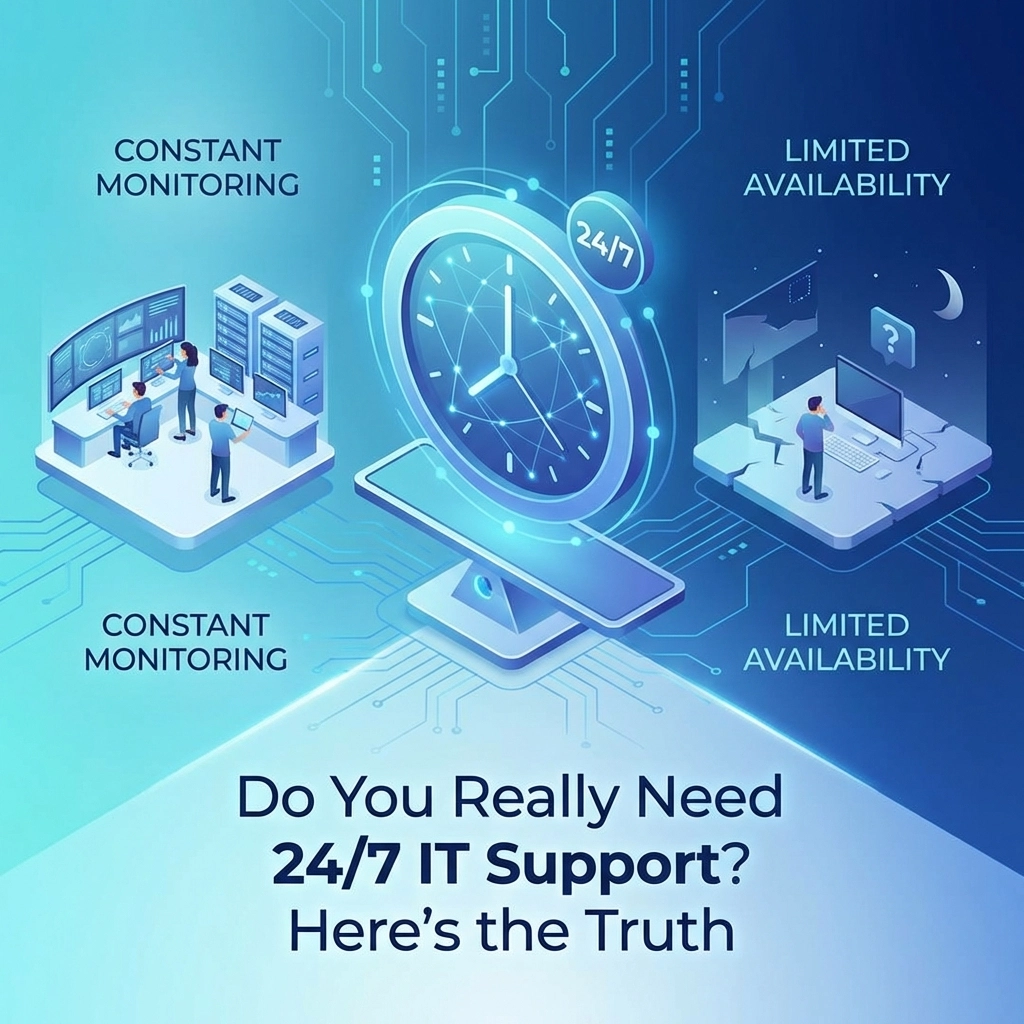
Let's be honest. When someone tries to sell you "24/7 IT support," your first thought is probably: Do I actually need someone available at 3 AM?
It's a fair question. And the answer isn't a simple yes or no.
The truth is, some businesses absolutely need round-the-clock coverage. Others? Not so much. The trick is figuring out which camp you fall into, before a midnight server crash makes that decision for you.
We're going to break this down properly. No scare tactics, no overselling. Just the facts so you can make the right call for your business.
What Exactly Is 24/7 IT Support?
Before we dive deeper, let's get clear on what we're actually talking about.
24/7 IT support means having access to technical assistance any time of day or night, every day of the week. This could include:
- Help desk support for employee tech issues
- Server and network monitoring to catch problems early
- Cybersecurity surveillance to detect and respond to threats
- Emergency response when critical systems go down
This doesn't necessarily mean someone sitting in an office watching your systems at 2 AM (though it can). Often, it's a combination of automated monitoring tools and on-call technicians ready to jump in when something flags up.
The key difference from standard business-hours support? Problems don't wait until Monday morning to get fixed.
At iTechmonster, we do 24/7 the smart way—proactive monitoring and rapid response so things don't break in the first place. And we make sure your data is safe with verified daily backups.

Signs Your Business Actually Needs 24/7 Support
Right, let's get practical. Here are the scenarios where round-the-clock IT coverage genuinely makes sense:
You Operate Outside Traditional Hours
If your business runs evening shifts, weekend operations, or serves customers around the clock, your IT support should match. A restaurant chain with late-night locations, an e-commerce store that never closes, or a manufacturing facility running overnight shifts: all need tech support when their people are actually working.
You Have Remote or Global Teams
Got employees spread across different time zones? Someone's always working. And when Sarah in Australia hits a login issue at her 9 AM (your 11 PM), she shouldn't have to wait 10 hours for help. That's a full day of lost productivity.
Downtime Costs You Real Money
This is the big one. Ask yourself: What happens if our systems go down for an hour? What about four hours? A full day?
For some businesses, an hour of downtime is an inconvenience. For others, it's thousands of pounds in lost sales, missed deadlines, or damaged customer relationships. If you fall into the second category, the maths on 24/7 support starts looking very different.
You Handle Sensitive Data
Cyber attacks don't clock off at 5 PM. In fact, many hackers specifically target businesses during off-hours when they know response times are slower. If you're handling customer payment details, personal information, or confidential business data, continuous security monitoring isn't paranoia: it's common sense.
You've Been Burned Before
Sometimes the best teacher is experience. If you've already had a weekend outage that spiralled into a crisis, or a security incident that went undetected for hours, you already know the value of always-on coverage.
When You Might Not Need It
Here's where we keep it real. Not every business needs 24/7 support, and paying for it when you don't is just wasting money.
You probably don't need round-the-clock coverage if:
- Your entire team works standard 9-to-5 hours
- Your systems aren't customer-facing or revenue-critical overnight
- You have minimal IT infrastructure to monitor
- Downtime would be frustrating but not financially devastating
A small accounting firm that closes at 6 PM and doesn't process transactions overnight? Standard business-hours support with good proactive maintenance is likely plenty.
The key is being honest about your actual risk level: not the worst-case scenario you can imagine, but the realistic impact of overnight issues.

The Real Cost of Downtime
Let's talk numbers for a moment, because this is where the decision often gets made.
According to industry research, the average cost of IT downtime for UK businesses ranges from £4,000 to £5,000 per hour for mid-sized companies. For larger enterprises or those with high-volume online transactions, that figure can climb significantly higher.
But it's not just about immediate revenue loss. Consider:
- Employee productivity – Staff sitting idle or working inefficiently
- Customer trust – People remember when your service wasn't available
- Recovery costs – The longer issues go unaddressed, the more complex (and expensive) they become to fix
- Reputation damage – Especially if downtime becomes a pattern
When you weigh the monthly cost of 24/7 support against even a single significant outage, the investment often pays for itself.
The Benefits Beyond Emergency Response
Here's something that often gets overlooked: good 24/7 IT support isn't just about fixing problems at odd hours. It's about preventing problems in the first place.
With continuous monitoring, we can:
- Spot warning signs early – A server showing unusual memory usage at 2 AM gets flagged and addressed before it crashes during your busiest trading hours
- Apply updates and patches during off-peak times – No more disrupting your workday for essential maintenance
- Track performance trends – Identifying issues that are slowly developing, not just ones that have already exploded
- Respond to security threats immediately – Containing breaches before they spread
- Perform and verify daily backups – So recovery is clean and fast if you ever need it
Think of it less like having a fire brigade on standby, and more like having a smoke detector that's always watching.

In-House vs Outsourced: What Makes Sense?
If you've decided 24/7 coverage makes sense for your business, the next question is: build it yourself or bring in outside help?
Building an in-house 24/7 team means hiring multiple IT staff to cover all shifts, plus management overhead, training, holiday cover, and the technology to support them. For most small and medium businesses, this is prohibitively expensive.
Outsourcing to a managed IT provider gives you access to a full team of specialists without the payroll commitment. You get the coverage you need at a fraction of the cost of building it yourself.
At iTechmonster, we provide IT support packages that scale with your needs. Whether you need full 24/7 monitoring or just extended hours coverage, we can build something that fits your business and your budget.
Pricing starts from £99/month—you get a full IT team on hand, proactive monitoring, and daily backups, all for far less than hiring your own in-house team.
How to Decide What's Right for You
Still on the fence? Here's a simple framework:
Ask yourself these questions:
- When do my employees actually work?
- When do my customers interact with my systems?
- What would a 4-hour outage cost me in real terms?
- How quickly do I need security threats addressed?
- Have I had overnight issues in the past, and how were they handled?
If your answers point toward risk: significant financial impact, customer-facing systems, or previous incidents: 24/7 support deserves serious consideration.
If your answers suggest low overnight risk and contained impact, you might be better served by solid business-hours support with good preventive maintenance.
The Bottom Line
24/7 IT support isn't a luxury for every business, but it's not unnecessary paranoia either. It's a practical decision based on your specific operations, risk tolerance, and the real cost of things going wrong.
For businesses where systems need to run continuously, where downtime means lost revenue, or where security threats demand immediate response: round-the-clock support isn't optional. It's essential.
For others, smart business-hours support with proactive monitoring might be the better fit.
Not sure which category you fall into? We're happy to chat it through. Get in touch and we'll help you figure out exactly what level of coverage makes sense for your situation: no pressure, no hard sell. Just honest advice from people who've seen what works.